What if . . . ?: A Search for Answers

This blog is a bottle flung into the sea of information. I am isolated on my isle of infinite questions, earnestly seeking answers and dialogue. I hope this blog will carry my thoughts to the farthest reaches of the globe, and ultimately stimulate a insatiable thirst for knowledge and Truth.

Tuesday, January 13, 2009

Extreme Sports?

I was talking to a friend the other day, and after briefly discussing what sorts of traits are inherited genetically, we got to talking about extreme sports. It's amazing to me that anyone could learn to drive a dirt-bike off a 30-some foot ramp, jump 15 feet in the air on a half-pipe, or grind rails on a stunt bike. For anyone to learn any skill, some level of trial and error is required. In such extreme sports, however, mistakes can often be incredibly painful. After experiencing pain, most people are either wired to avoid the pain, or they will at least flinch when performing similar actions. Could it be that "extreme" athletes are genetically predisposed not to learn from painful experiences?

Perhaps some level of their "bad-ass" personae can be attributed to that genetic predisposition as well... Momma's spanking just didn't have any effect, haha.

Wednesday, January 7, 2009

there was no such thing as chance?

1 in 6 wins a free coke... Collect all the game pieces to win ... Open to get your chance at winning a trip to the Pro bowl...

I've seen them, and I have even bought them. I know I'm going to simply end up with some 7 digit code that I would never go through the trouble of looking up, and yet, I still choose that product over others. What is it about chance that governs so much of our human behavior?

If I tell someone that there is a one in one million chance that they will win the lottery, that person might go ahead and buy a lottery ticket. If I tell that same person that there is a one in one million chance that their plane will crash they might not get on that plane. Of course there are other factors that play into such decision making processes, but how much of existence is governed by chance???


Sunday, January 4, 2009

Should You Make Your Kids Read Out Loud?


I remember in the second grade, our teacher used to make us read aloud in groups. I didn't think much of it at the time, I could read fine. Wasn't the point just to test our reading ability? 

A second memory I have is of sleeping over at a friends house a few years later. My friend's mother used to make him and his brother read aloud from the Bible each night and have them make their own interpretations of some more cryptic passages. Now, they are both linguistically gifted, and the brother is on his way to Harvard Law School. I am assuming that this has partially to do with an exceptional ability to communicate.

Finally, I have realized that while I, myself, am able to communicate fairly well on paper, I have a much harder time communicating verbally. My brain works much faster than my lips (or maybe my lips work much slower than my brain), and hence I am often stumbling over my own words.

These experiences have led me to wonder. In psychology and biology, I have often heard of a condition called aphasia, a condition caused by damage to the brain that results in either partial or total loss of the ability to articulate ideas or comprehend written or spoken language (America
n Heritage Dictionary). 
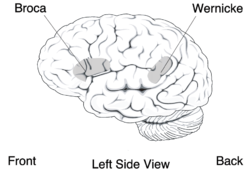
Various forms of aphasia are associated with two areas of the brain called Broca's area and Wernicke's area. While Broca's area, for the most part, is associated with language production, Wernicke's area is associated with language comprehension (for more information, wiki Broca's area and Wernicke's area). Thus, a person with damage to Broca's area may know what they want to say, but be unable to articulate it. A person with damage to Wernicke's area may be able to articulate words, but not in a meaningful manner (There's a nice House episode that covers this).

Therefore, my question is this: Does making kids (or adults even) read out loud strengthen the connection between Broca's and Wernicke's area, and hence, does it improve their ability to communicate?