Should You Make Your Kids Read Out Loud?
I remember in the second grade, our teacher used to make us read aloud in groups. I didn't think much of it at the time, I could read fine. Wasn't the point just to test our reading ability?
A second memory I have is of sleeping over at a friends house a few years later. My friend's mother used to make him and his brother read aloud from the Bible each night and have them make their own interpretations of some more cryptic passages. Now, they are both linguistically gifted, and the brother is on his way to Harvard Law School. I am assuming that this has partially to do with an exceptional ability to communicate.
Finally, I have realized that while I, myself, am able to communicate fairly well on paper, I have a much harder time communicating verbally. My brain works much faster than my lips (or maybe my lips work much slower than my brain), and hence I am often stumbling over my own words.
These experiences have led me to wonder. In psychology and biology, I have often heard of a condition called aphasia, a condition caused by damage to the brain that results in either partial or total loss of the ability to articulate ideas or comprehend written or spoken language (America
n Heritage Dictionary).
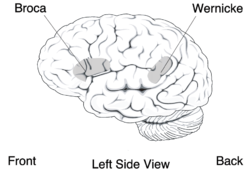
Various forms of aphasia are associated with two areas of the brain called Broca's area and Wernicke's area. While Broca's area, for the most part, is associated with language production, Wernicke's area is associated with language comprehension (for more information, wiki Broca's area and Wernicke's area). Thus, a person with damage to Broca's area may know what they want to say, but be unable to articulate it. A person with damage to Wernicke's area may be able to articulate words, but not in a meaningful manner (There's a nice House episode that covers this).
Therefore, my question is this: Does making kids (or adults even) read out loud strengthen the connection between Broca's and Wernicke's area, and hence, does it improve their ability to communicate?
posted by Caleb @ 4:08 PM


<< Home